


PROJECT ID
Finance
Instrument: International Visegrad Fund
Action Type: Social entrepreneurship, capacity building, ecosystem
assessment, regional cooperation and policy advocacy
Project Status: Completed
Implementation Period:
Funded by: The project is financed by the Governments of
Czechia, Hungary, Poland and Slovakia, through the Visegrad Grants Program from
the International
Visegrad Fund. The mission of the fund is to advance ideas
for sustainable regional cooperation in Central Europe.
Lead Organisation: Youth Alliance – Krusevo, North Macedonia
Project Partners: The project is implemented by Youth Alliance -
Krusevo in partnership with CDP Globus (Bosnia and Herzegovina), Forum for Civic Initiatives (Kosovo), Center for Youth Education (Montenegro), Mission: Recconect (Czechia), Slovak Open
Solidarity (Slovakia), FISE (Poland), and Foundation for Sustainable Enterprises (Hungary). The
project is financed by the Governments of Czechia, Hungary, Poland and
Slovakia, through the Visegrad Grants Program from the International Visegrad
Fund. The mission of the fund is to advance ideas for sustainable regional
cooperation in Central Europe.
Beneficiary Countries: North Macedonia, Bosnia and Herzegovina,
Kosovo, Montenegro, Czechia, Hungary, Poland and Slovakia
Main Aim
The project aimed to strengthen social entrepreneurial
ecosystems in the Visegrad and Western Balkan regions by improving the
capacities of civil society organisations, social enterprises and other
relevant stakeholders to assess their national environments, identify systemic
gaps and develop evidence-based recommendations. Through regional training,
national assessments, stakeholder consultations and policy dialogue, the
project promoted cooperation, knowledge exchange and the development of more
inclusive and supportive conditions for social enterprises.
Project Logic
IF civil society organisations, social entrepreneurs and ecosystem stakeholders are equipped with a shared assessment methodology, practical knowledge and opportunities for regional cooperation, AND IF evidence from national ecosystems is systematically collected and communicated to decision-makers, THEN stakeholders will be better positioned to identify gaps, advocate for policy improvements and contribute to more sustainable and supportive social entrepreneurial environments across the Visegrad and Western Balkan regions.

KEY ACHIEVEMENTS
Capacity building and methodological development
An international training in Olomouc, Czechia, brought together 17
participants from the Visegrad and Western Balkan countries. During the
three-day programme, participants strengthened their knowledge and practical
skills for assessing social entrepreneurial ecosystems and developed national
action plans adapted to their respective contexts.
All participants reported increased competencies for applying the
assessment methodology. In addition, 85% improved their understanding of
ecosystem assessment, 90% identified potential regional partnerships and 80%
felt better prepared to address gaps in their national environments.
National ecosystem
assessments
The common
assessment methodology was applied in eight participating countries: North
Macedonia, Bosnia and Herzegovina, Kosovo, Montenegro, Czechia, Hungary, Poland
and Slovakia.
Eight national
reports were developed, presenting country-specific findings related to:
- legal and institutional frameworks;
- financing opportunities and funding gaps;
- support structures and stakeholder networks;
- capacity-building needs;
- cooperation among institutions, civil society and social
enterprises;
- conditions affecting the sustainability and growth of social
enterprises.
Stakeholder
engagement
A total of 173
representatives of social enterprises, civil society organisations, public
institutions and other ecosystem actors participated in workshops, interviews
and consultations.
Each partner
organised national activities to introduce and apply the assessment
methodology, collect evidence and involve relevant stakeholders in identifying
challenges, opportunities and potential solutions.
Regional cooperation
and networking
The project
strengthened cooperation among eight partner organisations and connected social
entrepreneurs, civil society representatives, experts, researchers,
institutions and policymakers from the two regions.
The exchange of
national experiences enabled partners to identify common challenges,
transferable practices and opportunities for continued collaboration between
the Visegrad and Western Balkan countries.
International policy
dialogue
The International
Round Table on Supportive Social Entrepreneurial Ecosystems gathered more than
70 participants from eight countries.
Participants
discussed legal recognition, access to finance, institutional support,
sustainability and the potential for scaling social enterprises. More than 80%
of participants actively contributed to workshops and policy discussions.
The round table
resulted in practical recommendations for stronger cross-sector cooperation,
improved access to funding and more supportive policy and regulatory
frameworks.
Research and
evidence-based advocacy
The national
findings were consolidated into regional conclusions, a final report and a
policy paper.
These publications
provide comparative evidence about the state of social entrepreneurial
ecosystems and offer practical recommendations for public institutions, donors,
civil society organisations, social enterprises and other relevant
stakeholders.
Awareness raising
and dissemination
The project
implemented coordinated communication and dissemination activities across all
participating countries.
The international
training campaign reached approximately 5,600 people online, while the national
reports were shared directly with more than 500 stakeholders. Social media
promotion of the reports reached over 3,000 people and generated more than 200
direct interactions.
The International
Round Table campaign reached more than 1,000 people, with approximately 300
real-time interactions. Reports, recommendations and communication materials
were further distributed through partner networks, mailing lists, media outlets
and stakeholder platforms.

MAIN RESULTS AND
OUTPUTS
- One international capacity-building training implemented in Olomouc,
Czechia
- 17 participants trained in social entrepreneurship ecosystem
assessment
- One common methodology for assessing social entrepreneurial
ecosystems applied
- Eight national social entrepreneurship ecosystem assessments
conducted
- Eight national reports produced and published
- 173 stakeholders involved in national workshops, interviews and
consultations
- National in-person and online stakeholder activities organised
across the participating countries
- One International Round Table with more than 70 participants
implemented
- Representatives from eight countries engaged in regional dialogue
and networking
- One regional report developed
- One policy paper with recommendations produced
- Gaps in legal frameworks, financing and institutional support
identified
- Actionable recommendations for policy reform and cross-sector
cooperation developed
- Capacities of civil society organisations and social
entrepreneurship stakeholders strengthened
- Cooperation between the Visegrad and Western Balkan regions
increased
- New partnerships and opportunities for future joint initiatives
identified
- Project findings disseminated to institutions, social enterprises,
civil society organisations, experts and policymakers
LONG- TERM CONTRIBUTION
The project created
a shared evidence base and strengthened the capacity of regional actors to
understand and improve social entrepreneurial ecosystems.
Its findings provide a foundation for future policy advocacy, capacity-building programmes, regional funding initiatives and cooperation with public institutions, financial actors and international development organisations. The partnership will continue exploring joint projects, policy dialogue and practical support mechanisms for social enterprises in the Visegrad and Western Balkan regions.
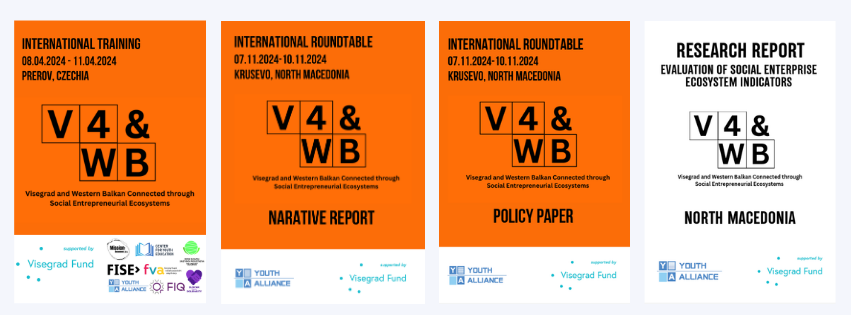
International training report International round table report Policy paper Research report MKD Research report SLO Research report MNG
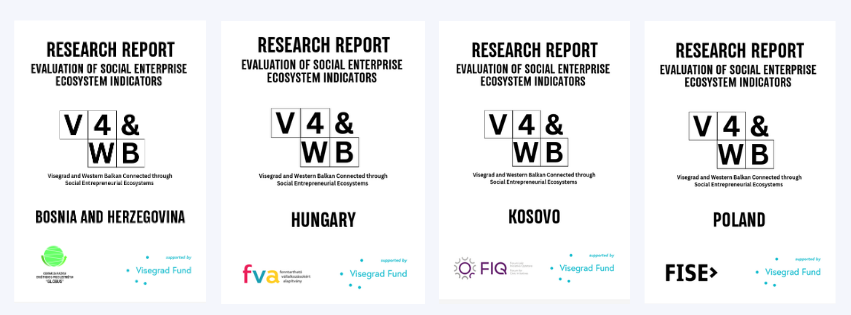
Research report BiH Research report HU Research report XK Research report PL


